Gītā basics
Who Is Kṛṣṇa? What the Bhagavad-gītā Says
In the Bhagavad-gītā, Kṛṣṇa says He is the source of everything, the Supreme Truth, and the Lord in everyone's heart, who appears in every age to protect the good. Arjuna accepts Him as the Supreme Person. Here is what Kṛṣṇa says about Himself, verse by verse, explained simply.
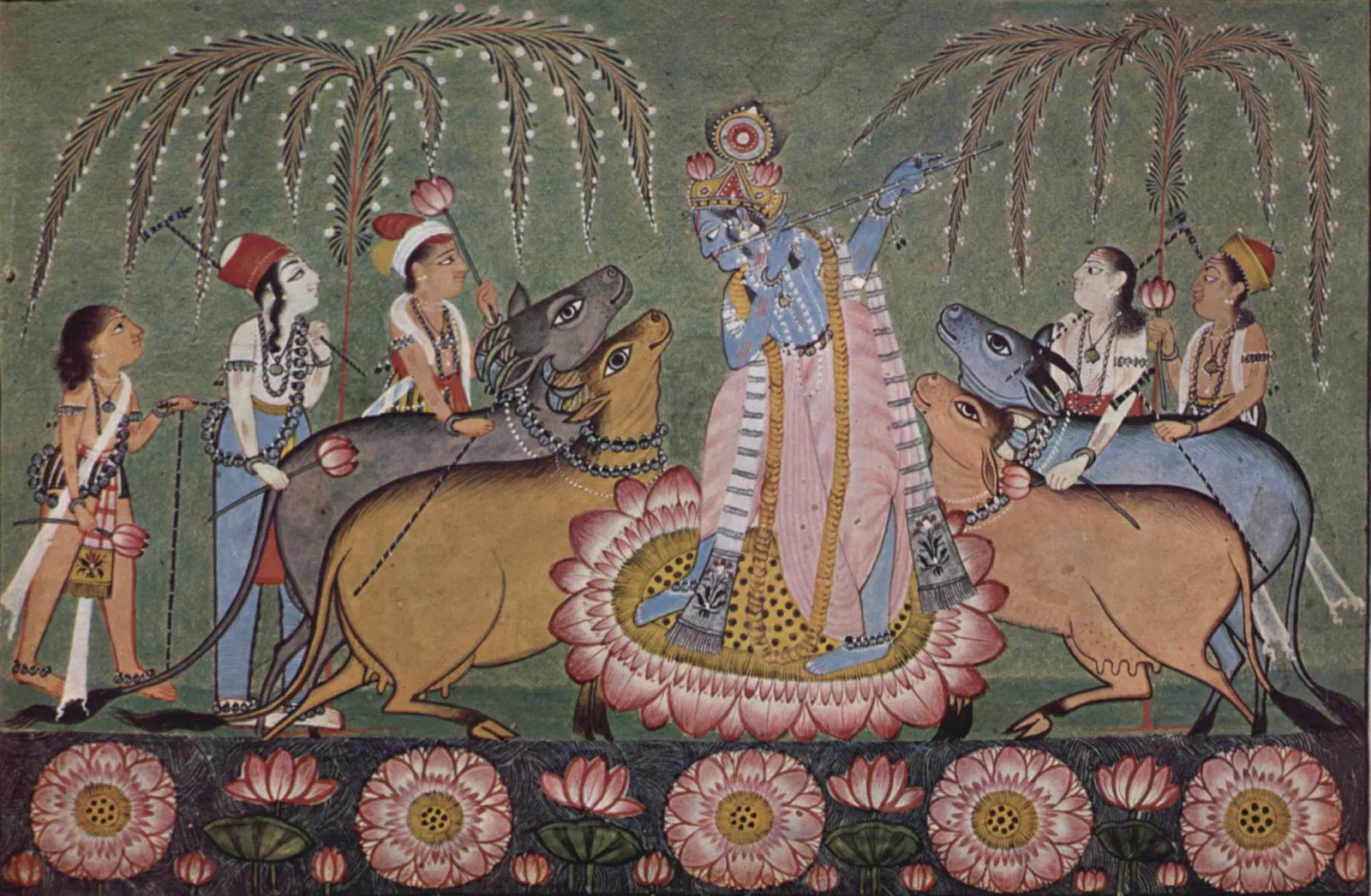
Short answer: In the Bhagavad-gītā, Kṛṣṇa says He is the source of all spiritual and material worlds BG 10.8, that there is no truth higher than Him BG 7.7, and that He lives in everyone's heart BG 15.15. He appears in this world, again and again, to protect good people and re-establish dharma BG 4.7–BG 4.8. Arjuna, after hearing Him, declares Him the Supreme Brahman and the original God BG 10.12–13. Śrīla Prabhupāda sums it up: "Kṛṣṇa is the Supreme Personality of Godhead, the cause of all causes, the primeval Lord Govinda" (purport to BG 7.3).
Kṛṣṇa in the Gītā: friend, teacher and Lord
In the Gītā, Kṛṣṇa is the charioteer of Arjuna on the battlefield of Kurukṣetra (purport to BG 7.3). He is Arjuna's very dear friend BG 18.65. But when Arjuna becomes confused and asks for guidance, Kṛṣṇa speaks as his teacher, and slowly reveals who He really is.
What does the name mean? Śrīla Prabhupāda explains:
"His name is Kṛṣṇa because He is all-attractive."
— Śrīla Prabhupāda, purport to BG 18.66
What Kṛṣṇa says about Himself
The clearest way to answer "Who is Kṛṣṇa?" is to listen to Kṛṣṇa's own words.
| What Kṛṣṇa says | Verse |
|---|---|
| No truth is higher than Me; everything rests on Me like pearls on a thread | BG 7.7 |
| I pervade the whole universe in My unmanifested form, yet I stay apart | BG 9.4 |
| Material nature works under My direction | BG 9.10 |
| I am the source of all spiritual and material worlds | BG 10.8 |
| I am the Self in all hearts; the beginning, middle and end of all beings | BG 10.20 |
| I am in everyone's heart; from Me come memory, knowledge and forgetfulness | BG 15.15 |
The most direct of these statements is this one:
ahaṁ sarvasya prabhavo
mattaḥ sarvaṁ pravartate
iti matvā bhajante māṁ
budhā bhāva-samanvitāḥ
I am the source of all spiritual and material worlds. Everything emanates from Me. The wise who know this perfectly engage in My devotional service and worship Me with all their hearts.
"Lord Kṛṣṇa is the source of all generations, and He is called the most efficient cause of everything."
— Śrīla Prabhupāda, purport to BG 10.8
mattaḥ parataraṁ nānyat
kiñcid asti dhanañjaya
mayi sarvam idaṁ protaṁ
sūtre maṇi-gaṇā iva
O conquerer of wealth [Arjuna], there is no Truth superior to Me. Everything rests upon Me, as pearls are strung on a thread.
"As far as Bhagavad-gītā is concerned, the Absolute Truth is the Personality of Godhead Śrī Kṛṣṇa, and this is confirmed in every step."
— Śrīla Prabhupāda, purport to BG 7.7
In a lecture in Vṛndāvana he explained the same verse simply:
"As the pearls are set up on a thread, standing—everything is dazzling—but they're all resting on the thread. Similarly, everything is resting on Kṛṣṇa. Kṛṣṇa is the support."
— Śrīla Prabhupāda, lecture on BG 7.7, Vṛndāvana, 13 August 1974 (transcript)
In the same purport Śrīla Prabhupāda quotes the Brahma-saṁhitā, īśvaraḥ paramaḥ kṛṣṇaḥ sac-cid-ānanda-vigrahaḥ, and explains it:
"…the Supreme Absolute Truth Personality of Godhead is Lord Kṛṣṇa, who is the primeval Lord, the reservoir of all pleasure, Govinda, and the eternal form of complete bliss and knowledge."
— Brahma-saṁhitā 5.1, as explained by Śrīla Prabhupāda in the purport to BG 7.7
Why does Kṛṣṇa come to this world?
If Kṛṣṇa is the Supreme Lord, why does He take birth like a human being? He explains it Himself in Chapter 4.
ajo 'pi sann avyayātmā
bhūtānām īśvaro 'pi san
prakṛtiṁ svām adhiṣṭhāya
sambhavāmy ātma-māyayā
Although I am unborn and My transcendental body never deteriorates, and although I am the Lord of all sentient beings, I still appear in every millennium in My original transcendental form.
Kṛṣṇa does not get a new body as we do. He comes in His own eternal form.
"In other words, Kṛṣṇa appears in this material world in His original eternal form, with two hands, holding a flute. He appears exactly in His eternal body, uncontaminated by this material world."
— Śrīla Prabhupāda, purport to BG 4.6
yadā yadā hi dharmasya
glānir bhavati bhārata
abhyutthānam adharmasya
tadātmānaṁ sṛjāmy aham
Whenever and wherever there is a decline in religious practice, O descendant of Bharata, and a predominant rise of irreligion—at that time I descend Myself.
paritrāṇāya sādhūnāṁ
vināśāya ca duṣkṛtām
dharma-saṁsthāpanārthāya
sambhavāmi yuge yuge
In order to deliver the pious and to annihilate the miscreants, as well as to reestablish the principles of religion, I advent Myself millennium after millennium.
So He comes for three reasons: to protect the good, to remove the wicked, and to set religion right again. Śrīla Prabhupāda adds that His main purpose is to please His devotees:
"Therefore, the prime purpose of the Kṛṣṇa avatāra is to satisfy His unalloyed devotees."
— Śrīla Prabhupāda, purport to BG 4.8
Is Kṛṣṇa just a great man?
Many people think of Kṛṣṇa as a wise teacher or a hero of history. The Gītā shows that He is more than that. One simple sign: He remembers everything.
"The Lord has spoken about the peculiarity of His birth: although He may appear like an ordinary person, He remembers everything of His many, many past "births," whereas a common man cannot remember what he has done even a few hours before."
— Śrīla Prabhupāda, purport to BG 4.6
Śrīla Prabhupāda often explained it in a very simple way:
"What is God? God means the Supreme Person. That's all. Just like I am person; you are also person. You may be bigger in quality, in opulence, than me, and somebody else may bigger..., may be bigger than you, somebody else bigger than him. So similarly you go on, searching after who is the biggest. Then you come to Kṛṣṇa. Kṛṣṇa is person."
— Śrīla Prabhupāda, lecture on BG 9.10, Calcutta, 29 June 1973 (transcript)
Arjuna himself, after hearing Kṛṣṇa, accepts Him as the Supreme Lord. He also says that great sages like Nārada, Asita, Devala and Vyāsa declared the same.
arjuna uvāca
paraṁ brahma paraṁ dhāma
pavitraṁ paramaṁ bhavān
puruṣaṁ śāśvataṁ divyam
ādi-devam ajaṁ vibhum
āhus tvām ṛṣayaḥ sarve
devarṣir nāradas tathā
asito devalo vyāsaḥ
svayaṁ caiva bravīṣi me
Arjuna said: You are the Supreme Brahman, the ultimate, the supreme abode and purifier, the Absolute Truth and the eternal divine person. You are the primal God, transcendental and original, and You are the unborn and all-pervading beauty. All the great sages such as Nārada, Asita, Devala, and Vyāsa proclaim this of You, and now You Yourself are declaring it to me.
"It is not because Kṛṣṇa is an intimate friend of Arjuna that he is flattering Him by calling Him the Supreme Personality of Godhead, the Absolute Truth. Whatever Arjuna says in these two verses is confirmed by Vedic truth."
— Śrīla Prabhupāda, purport to BG 10.12
Kṛṣṇa is the source of all avatāras
The Lord has many forms, such as Viṣṇu, Nārāyaṇa, Rāma and Varāha (purport to BG 18.65). The Gītā teaches that Kṛṣṇa is the original one.
"But Lord Kṛṣṇa is the primeval Lord, the fountainhead of all avatāras."
— Śrīla Prabhupāda, purport to BG 4.8
Śrīla Prabhupāda also quotes the Caitanya-caritāmṛta to explain what the word avatāra means:
"The avatāra, or incarnation of Godhead, descends from the kingdom of God for material manifestation. And the particular form of the Personality of Godhead who so descends is called an incarnation, or avatāra."
— Caitanya-caritāmṛta, quoted by Śrīla Prabhupāda in the purport to BG 4.8
Kṛṣṇa and you
Kṛṣṇa is not far away. He says He is seated in your heart, giving you memory and knowledge BG 15.15. He calls Himself "the benefactor and well-wisher of all living entities" BG 5.29, and He promises to carry what His devotees lack and protect what they have BG 9.22.
Śrīla Prabhupāda gave an example to show why loving Kṛṣṇa includes loving everyone:
"The point is, if you love the root, then you love everything. Just like if you pour water on the root of the tree, then the branches, the flowers, the leaves, the fruits and everything is nourished."
— Śrīla Prabhupāda, lecture on BG 10.8, New York, 11 January 1967 (transcript)
How can we know Kṛṣṇa?
Kṛṣṇa says that out of many thousands of people, hardly one knows Him in truth BG 7.3. He also says how we can: by devotional service BG 18.55.
bhaktyā mām abhijānāti
yāvān yaś cāsmi tattvataḥ
tato māṁ tattvato jñātvā
viśate tad-anantaram
One can understand the Supreme Personality as He is only by devotional service. And when one is in full consciousness of the Supreme Lord by such devotion, he can enter into the kingdom of God.
And knowing Him truly brings the greatest result:
janma karma ca me divyam
evaṁ yo vetti tattvataḥ
tyaktvā dehaṁ punar janma
naiti mām eti so 'rjuna
One who knows the transcendental nature of My appearance and activities does not, upon leaving the body, take his birth again in this material world, but attains My eternal abode, O Arjuna.
"But the devotee, simply by understanding the transcendental nature of the body and activities of the Lord, attains the abode of the Lord after ending this body and does not run the risk of returning again to this material world."
— Śrīla Prabhupāda, purport to BG 4.9
A simple way to begin knowing Kṛṣṇa
- Hear Kṛṣṇa's own words. Read the Gītā, starting with Chapters 7, 9 and 10, where He speaks most about Himself.
- Hear about Him from a devotee. Śrīla Prabhupāda stresses learning in the disciplic succession, not by speculation (purport to BG 10.12).
- Chant His names. Kṛṣṇa reveals Himself to those who serve Him with love BG 18.55.
- Offer Him something with love. Even a leaf, a flower, fruit or water BG 9.26.
- Remember Him in daily life. "Always think of Me," He says BG 18.65.
Frequently asked questions
Who is Kṛṣṇa according to the Bhagavad-gītā?
Kṛṣṇa is the Supreme Personality of Godhead. He says He is the source of all spiritual and material worlds (10.8), that there is no truth superior to Him (7.7), and that He is seated in everyone's heart (15.15).
Is Kṛṣṇa God or an avatar of Viṣṇu?
The Gītā presents Kṛṣṇa as the Supreme Lord Himself. Śrīla Prabhupāda explains that Lord Kṛṣṇa is the primeval Lord, the fountainhead of all avatāras (purport to 4.8), and that the Lord's many forms, such as Viṣṇu, Nārāyaṇa and Rāma, are one and the same Supreme Personality of Godhead (purports to 4.9 and 18.65).
Why does Kṛṣṇa appear in this world?
To protect the pious, to destroy the miscreants and to re-establish the principles of religion, millennium after millennium (4.7–8). Śrīla Prabhupāda adds that the prime purpose is to satisfy His pure devotees (purport to 4.8).
What does Kṛṣṇa look like?
Śrīla Prabhupāda describes Kṛṣṇa's original form as having two hands and carrying a flute, a bluish boy with a beautiful face and peacock feathers in His hair (purport to 18.65), "as beautifully colored as a cloud" (purport to 6.47).
Who were Kṛṣṇa's parents?
Śrīla Prabhupāda mentions Devakī as the mother of Kṛṣṇa, with her husband Vasudeva (purport to 4.8), and also speaks of Kṛṣṇa as the son of Mother Yaśodā, who raised Him (purport to 6.47).
What does the name "Kṛṣṇa" mean?
It means "all-attractive". Śrīla Prabhupāda writes: "His name is Kṛṣṇa because He is all-attractive" (purport to 18.66).
Read next
Verses cited
BG 10.8BG 7.7BG 15.15BG 4.7BG 4.8BG 10.12–13BG 7.3BG 18.65BG 18.66BG 9.4BG 9.10BG 10.20BG 4.6BG 10.12BG 5.29BG 9.22BG 18.55BG 4.9BG 9.26